
- Home
- Who We Are

- What We Offer
- Client Testimonials
- Gallery
- Careers
- Enquiry

Bearing DAS Plate Assembly
We engineered a turnkey fixture solution for a healthcare OEM to enable assembly of a bearing and DAS plate directly from their packaging, with individual functional testing of each component prior to assembly and controlled transfer of the completed assembly to the CT gantry. The solution comprised four integrated fixtures—a fixed table and a tilt table for stationary loading and bearing–DAS plate assembly, a mini loader for transferring the bearing between tables and positioning the DAS plate on the tilt table, and an ostrich loader that picks up the assembled unit after a 90° rotation and loads it onto the CT gantry. Designed for ease of manoeuvrability and safe handling by women operators, the system achieved bearing parallelism within 50 microns on the fixed table, enabled functional testing before assembly, and ensured accurate alignment and secure mounting on the CT gantry. The complete process was demonstrated during a live Factory Acceptance Test at our facility, where the customer’s operators successfully ran the assembly using our fixtures prior to final acceptance.

Seasoner Upgrade Fixture
Edify Engineering Solution designed a state-of-the-art seasoning station for X-ray tube insert manufacturing. Built to process two inserts simultaneously, the system integrates precision HV design, automated anode/cathode connections, efficient oil cooling circulation, and comprehensive safety sensor interfaces. To eliminate manual loading, our team developed an innovative automated loader that lifts, loads, and unloads inserts through a simple key-switch control. Delivered in just 12 weeks, the system was installed for the first time right with zero HV arcing, ensuring maximum reliability and safety.

X Ray Manipulator
In collaboration with a specialized vendor, we developed a custom 5-axis X-ray manipulator for a defence organization to enable non-destructive inspection of aerospace components. The solution comprised a rigid column stand and C-arm assembly designed to support the X-ray source, flat panel detector (FPD), and the component under inspection, enabling precise alignment during scanning. The base assembly provided three axes of motion for linear movement and controlled rotation of the job, while the vertical frame incorporated mechanisms for vertical travel and tilting of the X-ray source and FPD. The complete inspection process was executed within a shielded lead chamber, with all movements and imaging operations remotely monitored and controlled via an external control panel, ensuring operator safety and process reliability.

Stepper Motor Characterization Test Rig
Edify Engineering Solution successfully executed an embedded systems project focused on developing a stepper motor characterization test rig with high precision. The objective of this system was to capture key performance parameters of stepper motors, including speed, current, torque, acceleration time, deceleration time, and other critical metrics essential for evaluating motor behaviour. To achieve this, Edify Engineering Solution designed and implemented a communication interface with the stepper motor and its integrated controller, which operates over the I²C protocol. The solution included a Python-based front-end application and an intermediary hardware device capable of encoding and decoding I²C communication between the PC and the motor controller. This embedded test system enabled the customer to seamlessly characterize motors from multiple suppliers, compare their performance, and confidently select the motor best suited for their application.

Worktable for Probes Assy Line
Edify Engineering Solution designed and delivered a turnkey manufacturing assembly line for a healthcare OEM within an 8-week timeline, enabling seamless assembly, testing, and packing of probes. Built using a modular circular aluminium profile system, the line provided a lightweight, ergonomic, and reconfigurable setup to support both current and future process requirements. The solution featured integrated power and network connectivity across all workstations; monitor, CPU, and keyboard mountings; smooth work-in-progress transfer through roller-enabled tables; and essential utilities including glove boxes, airgun and soldering-iron holders, exhaust provisions, signal tower placement, electrical routing, acrylic work surfaces, and name board placements. The delivered infrastructure comprised 45 assembly workstations and multiple finished-goods trolleys.

POC for Dolly Movement (Ergo risk reduction)
We developed a Proof of Concept (POC) tugger system for CT dolly movement, aimed at reducing ergonomic risks for operators as per the client’s requirements. This system mechanizes the pushing and pulling of CT dollies, offering up to 1-ton capacity and significantly reducing manual effort, repetitive strain, awkward postures, and peak load conditions. The POC features a compact, space-efficient powered drive unit with an ergonomic handle, allowing single-operator usage even in tight clinical spaces. It includes controlled acceleration and deceleration for smooth, safe manoeuvring, and a drive kill switch for emergency stop functionality. Designed for uniform hospital flooring, the tugger provides stable traction and precise control without affecting existing infrastructure. Fully battery-powered, it operates on a rechargeable, independent power source, ensuring uninterrupted mobility. Initial trials showed reduced operator exertion, improved control, and enhanced safety while remaining compatible with current CT dollies and workflows. Overall, the POC proves both technical feasibility and ergonomic effectiveness, forming a strong basis for further optimization, regulatory compliance, and transition to a production-ready solution.

Customer Complaint Analysis and Classification using AI ML Models
As part of our efforts to venture into providing software solutions, we developed an AI-based solution for a global healthcare organization that learns from large volumes of historical product complaints and automatically classifies new complaints into predefined categories. This enables customers to identify failure trends and take data-driven actions to improve product design—an activity traditionally performed manually. We first delivered a proof of concept within one month to demonstrate feasibility, followed by a fully functional production solution for one product line in four months. The solution significantly reduced manual effort and operational costs, while making the process more consistent. Based on its success, we were subsequently engaged to develop similar solutions for five additional product lines, all of which were delivered and deployed at the customer’s site within the same year. The solution also received a Technology Award from the customer’s senior leadership.
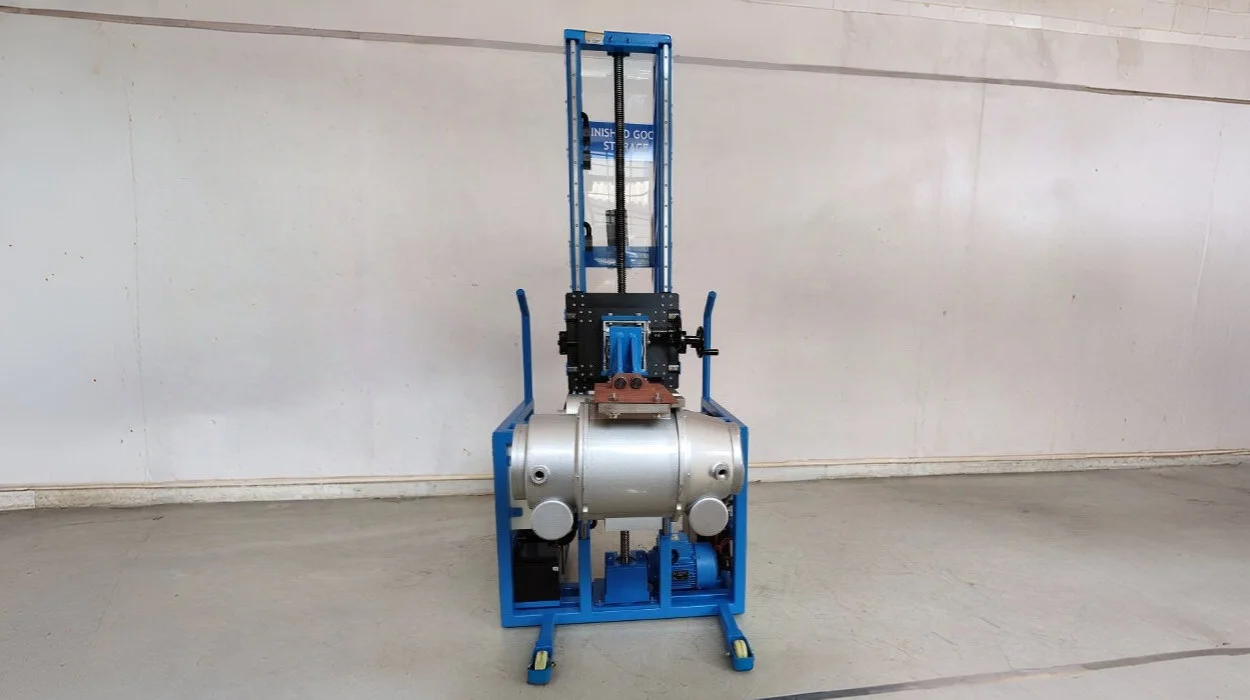
Tube & Generator Loading Fixture (TGLF)
Tube Generator Loading Fixture (TGLF) was a fixture developed by Edify for a healthcare OEM, to help load the CT tube and Generator onto a respective gantry. This fixture helped reduced inaccuracy, and enabled effective utilization of manpower, as the OEM was previously utilizing up to three personnel for loading the components using Pulley/Chain/Rod mechanism. The TGLF enabled the hoisting by means of an electric motor that helped in accurate raising of the generator or tube to the requisite height. The fixture arms were also designed to move horizontally to ensure the components could fit in their slots appropriately. The fixture could adjust the angle during generator movement & vary the vertical height of tube loading using the worm gear. Though the horizontal movement was manual, it was more accurate than the then existing method of hoisting as the fixture helped in holding the component in a steady state, which avoided the swaying movement with minimal manual intervention. This gave the operator time to gauge the component's position and load it on to its position, in a hassle-free way.
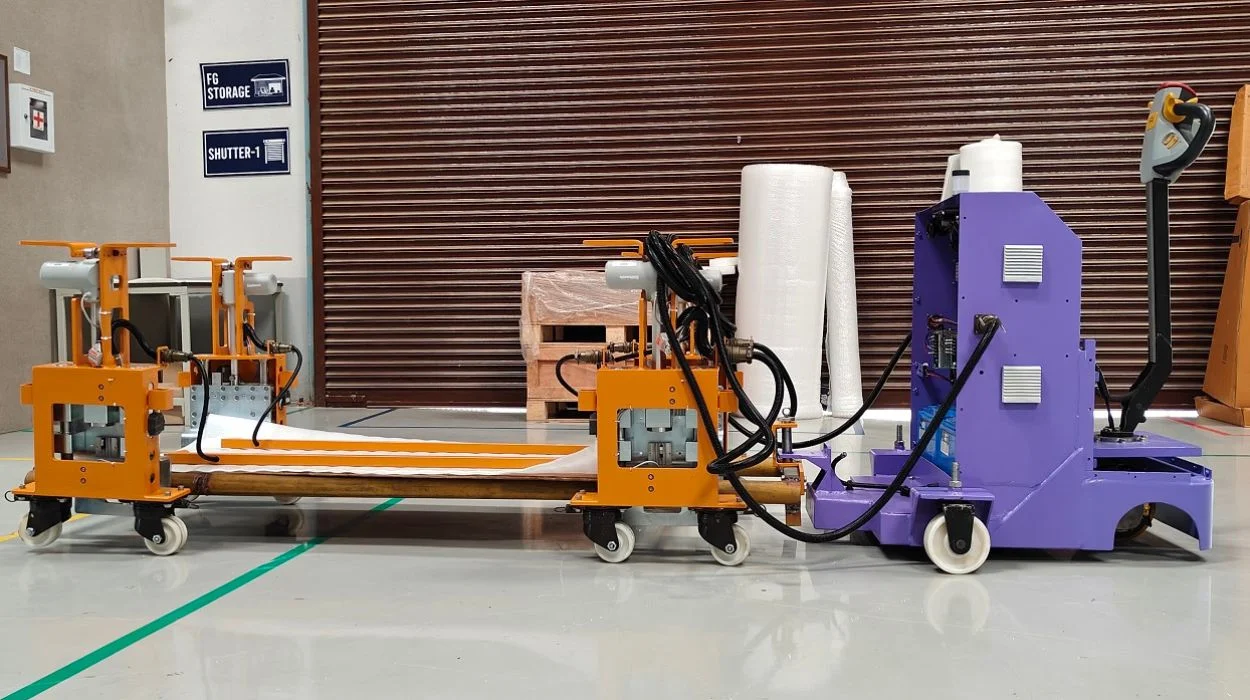
PET-CT Table Transfer Trolley (PCTT)
The PCTT was a transfer trolley developed for a healthcare OEM that had a basic fixture in place to lift the PET CT table and transport it from loading area to testing bay and from testing bay to packing facility. It was a manual fixture that worked on lead screw mechanism. The transportation of the table was done manually by using a castor wheel and a dolly. The PET CT table being quite heavy, weighs about 1T, and is loaded on to the test bay by lifting the four fixtures in each corner individually. This lead to non-uniform lifting of the table that further lead to errors in positioning, and cost both time and efforts. And this was where the PCTT pitched in, especially to semi-automate the process of lifting the PET CT table and ease the transportation of the table. The process of lifting was eased by means of linear actuators that ensured uniform movement of all four corners while either lifting or lowering. The movement of the PET CT Table was done using a transfer mechanism that was a part of the PCTT. Thus, both the movement of the table and the raising and lowering of the table was made easier to handle, reducing the human efforts required and saving time. This method proved to be ergo friendly in the loading and transferring of the PET-CT Table.
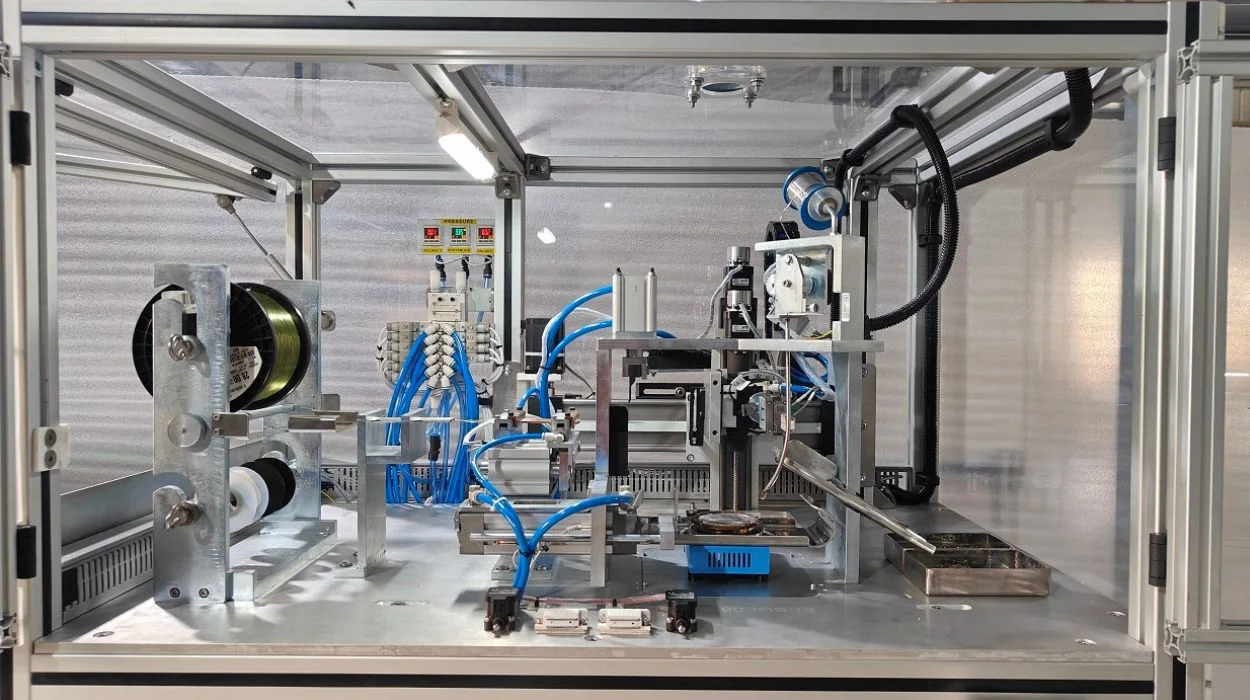
Wire Cut & Tinning Automation (WCTA)
The WCTA was a step ahead in solving a production line issue, presented to us, by our customer. In the existing setup of wire tinning used by them, there were two magnetic wires being fed into an actuator, which dispersed them at a uniform rate to be cut at equal intervals. which were then held by two support brackets, and both the ends of the cut magnetic wires were dipped in a molten tin bath, one after the other. The tinned wires were then collected in a bin. In a requirement that needed us to change few of the internal mechanisms, we developed the WCTA station, which was developed to support the feeding of four magnetic wires simultaneously. Some of the key challenges we rectified when compared to the previously used tinning station was that the ceramic brackets holding the cut magnetic wires moved all the way down to the tin bath, as against the solder pot being raised to enable dipping of the magnetic wires. Along with this we also introduced a slide to safely move the magnetic wires to the wire collecting bins, which was one up over the previous arrangement of the wire collecting bin also moving towards the solder pot. This development also eliminated the use of an additional actuator, while keeping the wire collecting bins at a safe distance from the heat of the solder pot. A three-axis gantry replaced the pneumatic cylinders for enhanced performance and reliability. Lastly, an automatic slag remover and auto tin feeding features were introduced to remove slag from the tin bath and to feed the tin wires at specified intervals.
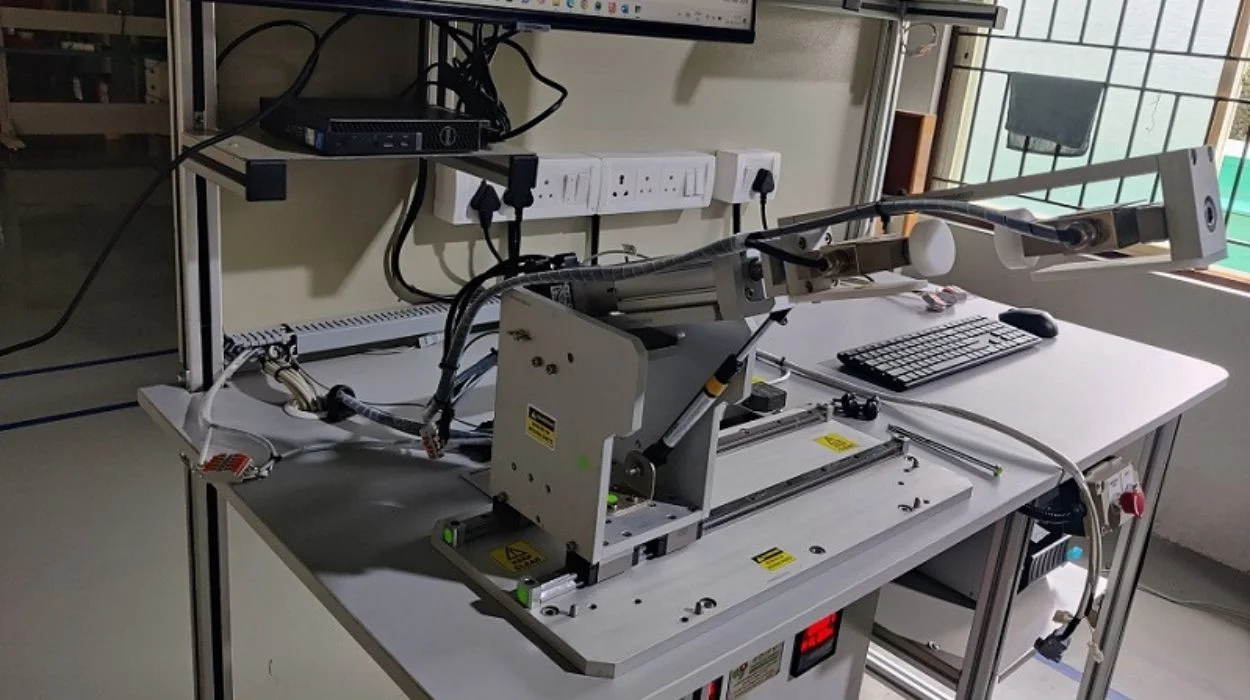
Mobile X Ray Handle Test Station
Any mobile X ray machine is a heavy structure. Being a mobile X ray machine, they are needed to have a simple manoeuvrability mechanism to move from one place to the other. This movement is controlled by its handle, including forward, reverse and steering movements. As per design, a sensing mechanism is incorporated in the handle assembly that provides an input to the system to engage the self-drive motor mechanism. Thus, the mobile X ray equipment shall be shifted from one place to another at ease, without much effort. This challenging project was handed to us by a healthcare OEM. As per the customer requirement, Edify developed a full-fledged test station, to confirm if the specifications of the sensing mechanism of the mobile X-ray machine's handle assembly were functioning properly. The architecture involved usage of servo motors, force measurement system, software, programmable logic control, and related electromechanical controls. This test station helped capture the handle movements' signals and verified if they were within the tolerances. Multiple tests were performed on the handle, and an exclusive program was developed to ensure that the PCB that was affixed in each handle was uniquely coded for traceability. The test station was provided with a report generation capability and captured the traceability, various tests, test data and results, which was put together in a document file.
